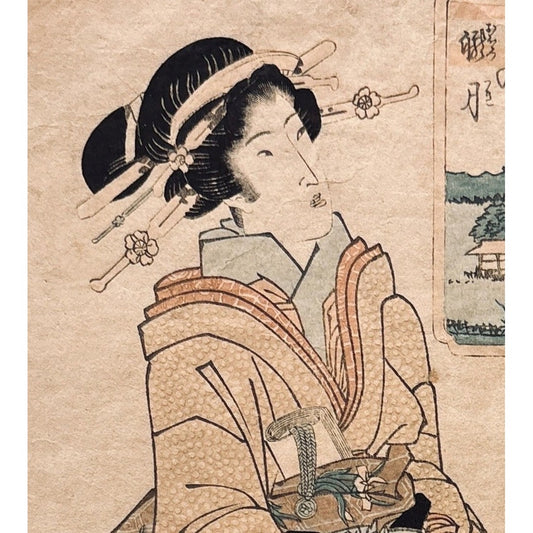
Keisai Eisen (1790–1848), also known as Ikeda Eisen, was a Japanese ukiyo-e artist and writer from Edo who studied with Kikugawa Eizan. He became one of the leading designers of bijin-ga, prints of beautiful women, and his large-head portraits (ōkubi-e) rank among the finest of the Bunsei era. He portrayed courtesans and geisha as more worldly figures, trading classical grace for frank sensuality, and also made surimono, erotic prints and landscapes.
Keisai Eisen (1790–1848, Edo, Japan), also known as Ikeda Eisen, was a Japanese ukiyo-e artist and writer. The son of a calligrapher, he first trained with the Kanō painter Kanō Hakkeisai, from whom he took the name Keisai, and after his father’s death studied with the ukiyo-e master Kikugawa Eizan. Eisen became one of the leading designers of bijin-ga, prints of beautiful women, and his large-head portraits (ōkubi-e) are counted among the finest works of the Bunsei era (1818–1830). Compared with earlier printmakers, he portrayed his courtesans and geisha as more worldly figures, replacing classical grace with a franker, more sensual presence. Alongside bijin-ga he produced surimono, erotic prints and landscapes. He began the series “The Sixty-nine Stations of the Kiso Kaidō”, which was completed by Utagawa Hiroshige. Eisen was also a man of letters: writing as Ippitsuan, he produced biographies of the Forty-seven Rōnin and added his own notes to the “Ukiyo-e Ruikō”, an early history of print artists. He belongs to the generation that, together with Kunisada and Kuniyoshi, shaped ukiyo-e in the first half of the 19th century. The woodblock print “Courtesan of the Tsuruya, Shin-Yoshiwara” (1825–1830), offered by TUMO Gallery, is an example of his bijin-ga depicting the celebrated courtesans of Edo’s licensed Yoshiwara district.