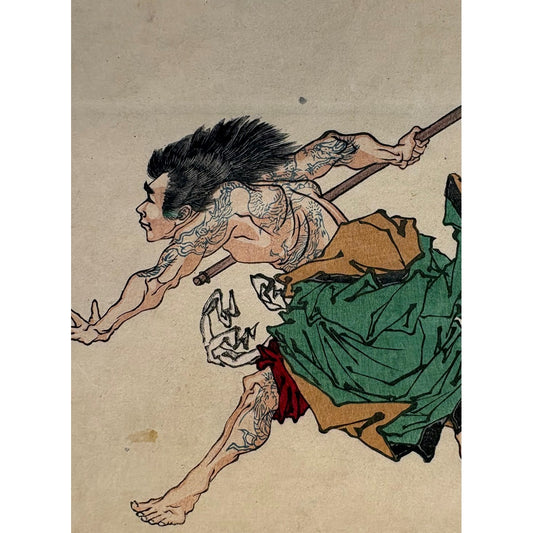
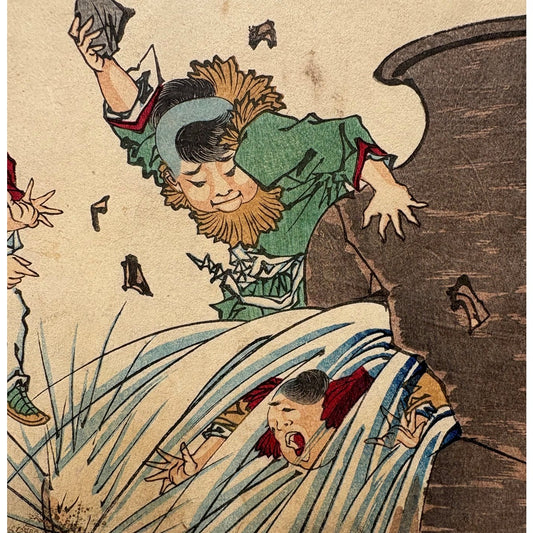
Tsukioka Yoshitoshi (1839–1892) was a Japanese printmaker widely regarded as the last great master of ukiyo-e, who entered Utagawa Kuniyoshi’s studio at the age of eleven. As Japan modernised in the Meiji era, he renewed the genre by combining ukiyo-e traditions with Western influences in drawing and composition. His masterpiece, the series “One Hundred Aspects of the Moon” (1885–1892), presents figures from history and legend in poetic, contemplative scenes.
Tsukioka Yoshitoshi (1839–1892) is widely regarded as the last great master of ukiyo-e woodblock printing. Born in Edo (present-day Tokyo), he entered the studio of the famous Utagawa Kuniyoshi at the age of eleven. His career spanned the dramatic transition from the Edo period to the Meiji era, when Japan modernised rapidly and traditional woodblock printing faced competition from photography and lithography. Yoshitoshi responded by renewing the genre, combining the traditions of ukiyo-e with Western influences in drawing and composition. His early work is known for its violent, dramatic imagery, reflecting the turbulent years of civil war. His masterpiece is the series “One Hundred Aspects of the Moon” (1885–1892), in which figures from Japanese and Chinese history, legend and literature appear in poetic, contemplative scenes linked by the motif of the moon. Other celebrated series include “New Forms of Thirty-Six Ghosts” and “Twenty-Eight Famous Murders with Verse”. Despite periods of poverty and illness, he trained many pupils and left an enormous body of work. Today his prints are held by major museums worldwide, including the British Museum and the Museum of Fine Arts, Boston.