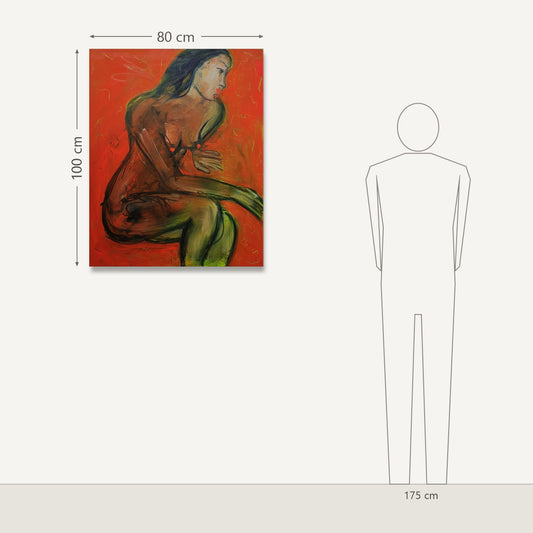
Luciano Castelli (b. 1951) is a Swiss painter, sculptor, photographer and performer, born in Lucerne. After moving to Berlin in 1978 he became one of the protagonists of the Neue Wilde; his work is held by MoMA in New York, and in 2015 the National Art Museum of China gave him a major exhibition. The human body is central to his expressive figurative painting, and in Paris he developed his “Revolving Paintings”, canvases with no fixed orientation.
Luciano Castelli (b. 1951, Lucerne, Switzerland) is a Swiss painter, sculptor, photographer and performer. He attended the preliminary course at the School of Applied Arts in Lucerne under Max von Moos and trained as a sign painter, and by the early 1970s he had become a central figure of Lucerne’s bohemian scene. He first gained international attention through Franz Gertsch’s photorealist paintings of his circle; the group portrait “Medici” became the cover image of Harald Szeemann’s documenta 5 (1972). In 1974 the curator Jean-Christophe Ammann included his androgynous self-portrait photographs in the exhibition “Transformer – Aspects of Travesty”. In 1978 Castelli moved to Berlin, where he joined the artists around the Galerie am Moritzplatz and became one of the protagonists of the Neue Wilde, whose expressive figurative painting rejected the austerity of 1970s conceptual art. He worked closely with Salomé and Rainer Fetting, and with Salomé he founded the punk band Geile Tiere. In 1989 he settled in Paris, where he developed his “Revolving Paintings”, canvases without a fixed orientation. In 2015 the National Art Museum of China in Beijing presented a major exhibition of his work, and his works are in collections including the Museum of Modern Art in New York. The oil painting “Philippines nude” (1985), offered by TUMO Gallery, comes from his Berlin years and shows the expressive treatment of the human body typical of the Neue Wilde.