Ivan Generalić (1914–1992) was a Croatian naïve painter and the central figure of the Hlebine School. A farmer by trade, he was discovered around 1930 by the painter Krsto Hegedušić and first exhibited with the Zemlja group in Zagreb in 1931. Working mainly in oil or tempera on the reverse of glass, he painted village life, farm labour and meticulously detailed Podravina landscapes with distinctive coral-like tree crowns.
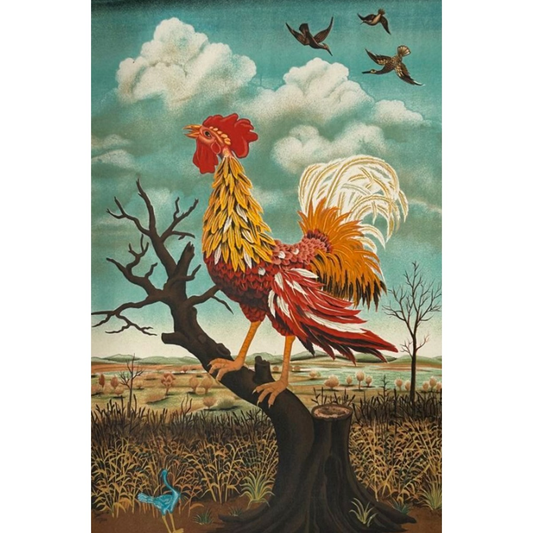
Ivan Generalić (1914–1992) was a Croatian naïve painter, born in the village of Hlebine near Koprivnica, and the central figure of the Hlebine School of naïve art. A farmer by trade, he showed a talent for drawing as a child and around 1930 was discovered by the painter Krsto Hegedušić, who taught him the fundamentals of the painter’s craft. In 1931 he exhibited for the first time with the Zemlja (Earth) group in Zagreb, showing drawings and watercolours marked by socially critical realism. Generalić worked mainly in oil or tempera on the reverse of glass, depicting village life, rural labour and the landscape of the Podravina region. His style combined folk imagery and the tradition of glass painting with echoes of Bruegel, the poetic naïvety of Henri Rousseau and surrealist elements, and he became known for meticulously detailed landscapes with characteristic coral-like tree crowns. He lived and exhibited in Paris in 1953, and his painting “The Deer Wedding” (1959) is regarded as one of his masterpieces. After 1970 his work turned towards symbolic and existential themes, often in a nearly monochrome palette. He led a school of peasant painters in Hlebine, whose later generations included his son Josip Generalić. He died in Koprivnica in 1992. The lithograph “Coq” (1968), numbered 27/100, offered by TUMO Gallery, translates his familiar rural imagery into print.