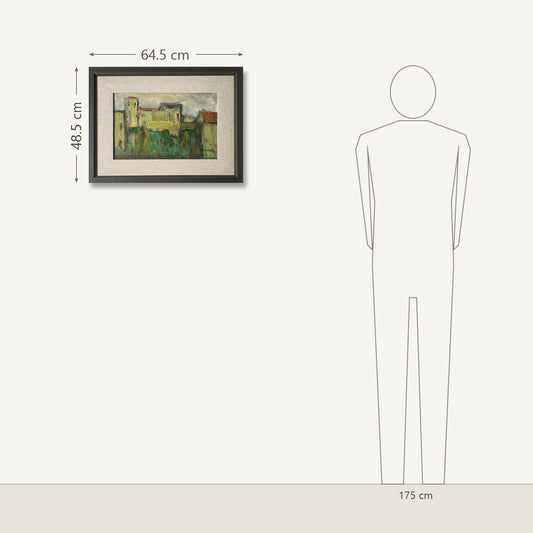
Alexander Bogen (born Katzenbogen; 1916–2010) was a Jewish painter and graphic artist from Vilnius, a partisan and one of the most important artists to document the Holocaust as it happened. Trained at Vilnius University and in Paris, he sketched the people and streets of the Vilna ghetto and, as a partisan, drew with charcoal from burnt branches on packing paper. His wartime drawings are held by Yad Vashem and the US Holocaust Memorial Museum.
Alexander Bogen (born Katzenbogen; 1916–2010) was a Jewish painter and graphic artist from Vilnius, a partisan and one of the most important artists to have documented the Holocaust as it happened. Born in Tartu, Estonia, into a family of doctors, he moved to Vilnius with his family as a small child and grew up there. He studied painting and sculpture at the Faculty of Fine Arts of Vilnius University and later also in Paris. After the German occupation in 1941 he was confined in the Vilna ghetto, where he sketched its residents and streets – an artist, as he later put it, recording “those doomed to death”. In 1943 he joined the partisans in the Naroch forest and helped lead the Jewish unit Nekamah (Revenge), returning to the ghetto shortly before its liquidation to lead young people out to the forest. Even there he kept drawing, on scraps of packing paper with charcoal made from burnt branches, and cut woodcuts for the partisans’ newspaper with a pen-knife. After the war he taught at art academies in Łódź and Warsaw, and in 1951 he settled in Israel, where he taught in Jerusalem and Tel Aviv. He remained active as a painter, printmaker and book illustrator until his death in 2010. His wartime drawings are held by Yad Vashem and the United States Holocaust Memorial Museum.